
Independent management advisors

Because managers need their own advisors in Management Buy-Outs (MBO).

David Ryckaert

You need us because :

In a traditional M&A process, management's interests are squeezed between the sellers' and the buyers' interests.

Managers must combine their full time job of running the business with the preparations of a transaction (preparing the data room, updating business plans, continuing financial reporting, management presentations etc.).

As a consequence, managers spend insufficient time on the proper negotiation of their own incentive package.

In addition, managers suffer from a lack of specialised knowledge and experience in the negotiation with professional investment funds and their specialised advisors.

Financial models, tax consequences and contractual mechanisms to protect management are complex. Studying them is time consuming.

At closing and in the aftermath of closing, management is compelled to signing documents potentially engaging their personal liability without having received independent advise thereon.

The lawyers of the buyer or the seller may offer to "take care of management to", but (i) grant no priority to that part of the transaction, (ii) offer no reliance to management as to their advice, and (iii) have an incentive to do the deal, independently of management's interests.

Therefore, independent, specialised advisors:

  • defend managers' interests ;
  • redress the imbalance in knowledge and experience ;
  • align managers' interests with the investment fund's interests;
  • review all documents required to be signed by management in the context of a transaction. Such review focuses on managers' potential personal liability, whereas review by the investor's lawyers is often limited to the validity of the documents in Newco's interest.

The Curve

The key concept in negotiating management incentive schemes is "retrocession": which part of the fund's gain is transferred to management under which conditions? 

The outcome of the negotiation is summarised in a curve (see non-representative example below):
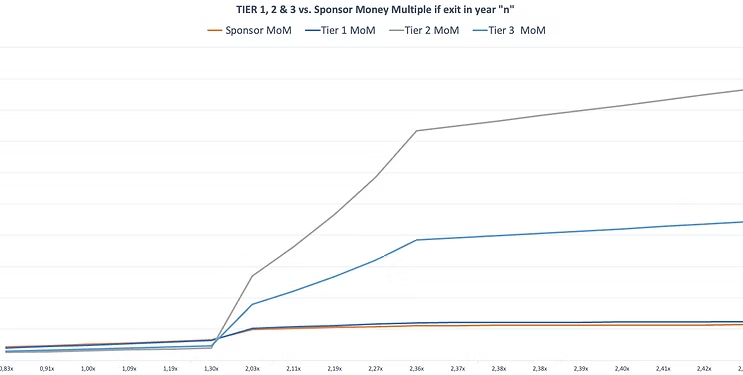
retrocession

Once the retrocession negotiated, financial instruments are defined. Every tier of management receives a mix of instruments, resulting in the above curves. Those instruments can consist of ordinary shares, preference shares, bonds, shareholder loans, options or warrants. They are grouped to form "pari passu instruments", "sweet equity" instruments, "financial yield" instruments or "ratchet" instruments. Every type of instrument has its own risk profile and as a consequence also its own tax treatment.
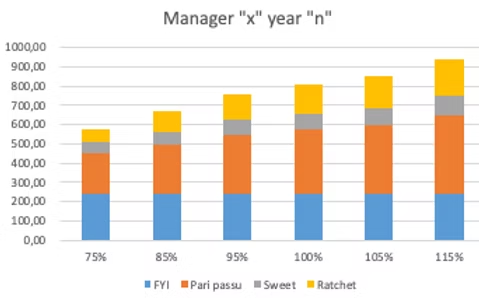
evolution

The non-representative example above shows how proceeds can be linked to financial yield instruments, pari passu instruments, sweet equity instruments and ratchet instruments in cases where the business plan is met for 75%, 85% etc. at a certain moment in the future.

Services

Negotiation of financials

We negotiate the financials of your management incentive scheme with candidate investors. 

In a competitive auction, we summarize all investors' offers in a single intelligible graph.

We use our experience to optimize retrocession in function of your business plan.  

Legal

We are lawyers. We draft a management term sheet early in the process and negotiate it with the investors. 

Thereafter, we implement the term sheet in final contract documentation. 

Click here for the main mechanisms included in a term sheet. 

Tax

We work with experienced, specialized tax advisors to find the best structure for your investment. 

This includes questions on the use of a personal holding company, a management company, self-employed or employee status, the use of stock options, international employment etc. 

We also advise on estate planning. 

Insights

Ouvrir le capital des participations LBO - tous actionnaires?

21 February 2024
Un article du Financial Times met en lumière une tendance récente vers une participation plus large au capital pour tous les employés des entreprises détenues par des fonds d’investissement…

Selling to oneself - Ponzi Scheme?

10 October 2023
Higher interest rates - lower valuations - limited exit options. Private equity fund managers are selling participations to "continuation funds" to avoid difficult exits, reveals the Financial…

The private equity club

15 August 2022
How corporate raiders became teams of rivals This article in the Financial Times describes how private equity funds turned from rivals into colleagues working together on deals. One of the the…

Credentials : not in public

We do not communicate in public on the deals we have worked on.

If you contact us using the form below or by e-mail, we may share credentials with you and introduce you to our existing clients for reference.